Cool Winter color palette
For high-contrast coloring with no trace of gold: icy blue, fuchsia, royal blue and black, every one with a blue base.
Find what fits me bestThe Cool Winter palette
Its best colors
- icy blue #DCEBF5
- fuchsia #D0006F
- royal blue #2A3FBF
- black #000000
- icy pink #F7D6E0
- cool charcoal grey #3E4450
Its neutrals
- pure white #FFFFFF
- silver grey #C0C4C8
- dark cool grey #5A6068
- true navy #1F2A5C
Colors that work against it
- pumpkin orange #CC5500
- olive green #708238
- mustard #D4A017
- terracotta #C0603A
- camel #C19A6B
- rust #A0522D
What the Cool Winter try-on shows
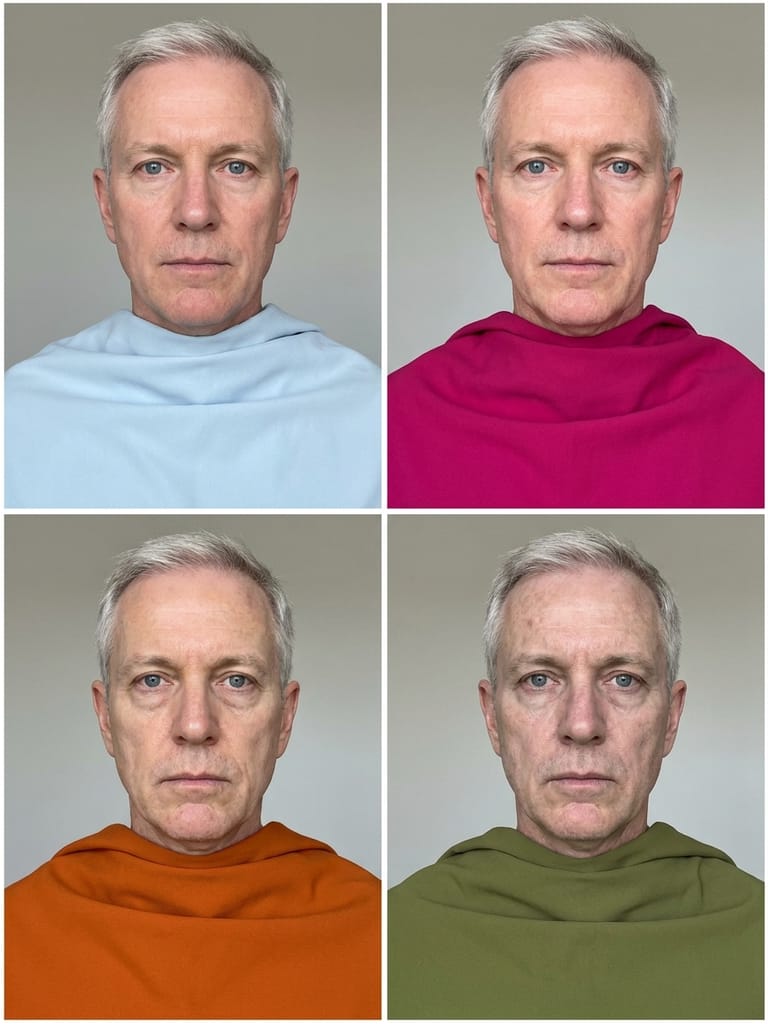 AI visualization
- Best
- icy bluefuchsia
- Worst
- pumpkin orangeolive green
- 1
Step 1 / 1
Take a selfie in daylight
Face a window, without makeup if you can, hair as it naturally falls. Daylight and no filter keep your real skin tone — colored lamps and beauty filters change the result.
Step 2 / 2
Find your season
The free color analysis reads your undertone, depth and contrast and tells you which of the 12 seasons you are, with your palette. Or pick a season yourself.
- Reading your skin undertone…
- Measuring the depth of your coloring…
- Checking the contrast of hair, skin and eyes…
- Matching you to one of the 12 seasons…
Analysis complete
Your best colors
Colors that work against you
AI visualization: you in four drapes, two of your best colors above two of your worst, the effect exaggerated. Uses one credit — your first try-on is free.
The analysis didn't work this time.
Or pick a season yourself
Your selfie is used for your reading and saved in your private Color Suite only if you go on to a try-on. Never shared, never used for training.
Free account · your first try-on is free
See your result — free
Create a free account to see your best and worst colors on you and keep them in your Color Suite. Your first try-on is on us.
We sent a 6-digit code to
We'll email you color ideas now and then — unsubscribe anytime with one click.
Also called True Winter, Cool Winter is the season led by a cool undertone, with clear coloring second. The hair is often dark ash brown or black, or silvers early; the eyes are cool and bright; the skin has a pink or cool olive cast at any depth. The contrast is high, but what defines you is that nothing in your face reads golden.
So every color in your palette has a blue base and a clean finish, from icy blue and icy pink through fuchsia and royal blue to black. The icy shades are near-whites rather than soft pastels, and they look best beside something dark that restores your contrast. Pure white, silver grey, dark cool grey and true navy are your neutrals.
Your neighbor across the family line is Cool Summer, just as cool but soft and lower in contrast. Within the winters, Deep Winter edges toward autumn and Bright Winter toward spring, which leaves Cool Winter as the purest cool of the three.
Cool Winter clothes and outfits
The easiest Cool Winter outfit pairs one icy shade with one dark one: an icy blue shirt under a true navy suit, an icy pink knit with black trousers, a silver grey sweater with a cool charcoal grey skirt. For more color, set fuchsia or royal blue against black. Pure white replaces cream and ivory.
Smooth, clean surfaces show your colors without blurring them: crisp cotton poplin, silk, satin, fine-gauge knits and sharp wool suiting, with a frosted sheen for the icy shades. Graphic, high-contrast prints suit you, like black-and-white stripes, polka dots or a bold abstract in fuchsia and black; blended florals in earthy tones do not.
Bright silver, platinum, white gold and polished steel echo your undertone. Yellow and rose gold tend to push the skin toward sallow, so wear a gold piece you love on the wrist rather than at the throat.
Cool Winter colors to avoid
The colors that work against a Cool Winter are the warm, earthy ones: pumpkin orange, olive green, mustard, terracotta, camel and rust. They oppose your main trait, golden where you are blue-based, and most are also a little muted where you are clear, so at the face they pull the skin toward yellow and flatten bright eyes.
Kept away from the face, a piece you love in one of them does far less harm, as camel trousers under a black sweater. When you shop, look for the cool version of the same piece: an olive field jacket in true navy, a camel coat in dark cool grey, and fuchsia for the punch you might look for in pumpkin orange.
Cool Winter makeup
Cool Winter makeup looks best clean and defined. Choose blue-based lips, such as fuchsia, a cool blue-red or a sheer icy pink for daytime, and skip orange-reds, coral and brown nudes. A touch of cool pink blush keeps the cheeks fresh where a golden bronzer would muddy them. For the eyes, black or charcoal liner gives the definition your contrast calls for, and silver or royal blue shadow adds color.
Hair colors for a Cool Winter
The season is read from the hair you were born with, usually ash brown, black or early silver for a Cool Winter. Cool dark brown, soft black, blue-black, and silver or white grey keep that coolness and often look striking with your eyes; golden, copper, caramel and strawberry tones tend to clash with the pink in your skin. Dyed hair can push a photo reading toward the wrong season, so if yours is colored warm, your brows show your coloring better.
How to wear the Cool Winter palette
- 1
Build on black, navy and grey
Black, true navy and dark cool grey make your coats and suits; pure white replaces every cream basic.
- 2
Pair icy shades with dark ones
Wear icy blue or icy pink next to black or navy, not head to toe, so the outfit keeps your contrast.
- 3
Add fuchsia or royal blue
One strong blue-based color near your face brightens your eyes more than any neutral can.
- 4
Keep metals and frames silver
Silver, platinum, white gold and steel repeat your undertone in jewelry, watches and glasses.
- 5
Check new colors against pure white
In daylight, lay it on a pure white sheet: if it looks yellowish or dusty there, it probably leans too warm or soft.
FAQ
Is Cool Winter the same as True Winter?
Yes. Twelve-season color analysis uses both names for the winter whose dominant trait is a cool undertone, with clear, high-contrast coloring second. "True" usually means winter in its purest form, leaning neither toward autumn nor toward spring.
What does a True Winter look like?
Typically dark ash brown or black hair, or hair that silvers early, cool eyes in blue, grey or dark brown, and skin with a pink or cool olive cast at any depth. Earthy colors tend to make this face look tired; black, pure white and icy shades make it look awake.
What is the difference between Cool Winter and Cool Summer?
Both are cool first. Cool Winter is clear and high in contrast, so black, pure white, fuchsia and royal blue suit it; Cool Summer is soft, with muted colors like raspberry and slate blue, and pure black tends to look harsh on it. If strong contrast sharpens your face, you probably lean winter.
Is there a Soft Winter season?
Not among the twelve this site reads. Sixteen-season systems use the name Soft Winter for a cool coloring with softer, lower contrast, and in the twelve such coloring usually reads as Cool Winter or Cool Summer, depending on how much contrast and clarity it has. If black and pure white look sharp on you, Cool Winter is the likelier fit; if they look heavy, Cool Summer.
Can a Cool Winter wear red?
Yes, if the red leans blue. A clear, cool red, closer to fuchsia than to tomato, works in a dress, a coat or a lipstick, especially with black or pure white. Orange-reds, brick and rust are the ones to skip, because their warmth tends to turn your skin sallow.
How do I find out if I am a Cool Winter?
Take a selfie in daylight in the color analysis at the top of this page and tap "Find what fits me best". It reads your undertone, depth and contrast and tells you which of the 12 seasons you are, with the reason and your palette. The analysis is free and needs no account.